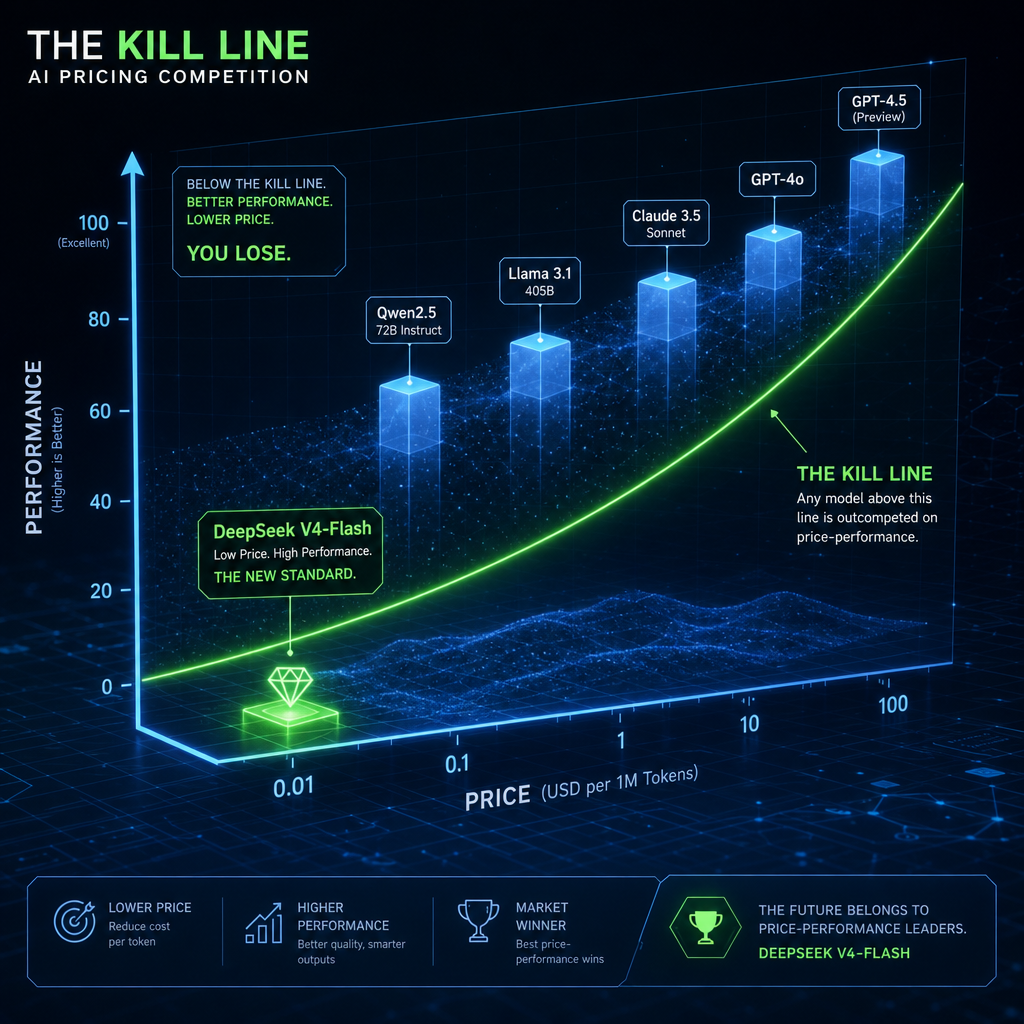
On August 4, 2026, “DeepSeek Kill Line” trended on Chinese social media. This wasn’t just another price adjustment—it marked a paradigm shift in AI from “luxury goods” to “public utilities.” Independent research firm Artificial Analysis reported that DeepSeek V4-Flash averages just 3 cents per test, 105 times cheaper than Anthropic’s Claude Fable 512. This benchmark line drawn on the “price-performance” coordinate system is rewriting global AI pricing rules.
The Kill Line: A Mathematical Business Reality
The “kill line” isn’t an official DeepSeek term but market shorthand for the price-performance frontier3. On Artificial Analysis’s scatter plot, DeepSeek V4-Flash occupies the optimal position: all models with worse performance and higher prices fall into the “kill zone”4.
The data reveals the line’s harsh reality: DeepSeek V4-Flash costs $0.14 per million input tokens and $0.28 per million output tokens5. By comparison, Moonshot’s Kimi K3 charges $3 and $15, while Anthropic’s Fable 5 costs $10 and $505. Looking only at output prices, DeepSeek is approximately 85 times cheaper than Claude Opus 4.84.
| Model | Input Price (per million tokens) | Output Price (per million tokens) | Artificial Analysis AI Index | Average Test Cost | vs. DeepSeek |
|---|---|---|---|---|---|
| DeepSeek V4-Flash | $0.14 | $0.28 | 50 | $0.03 | Baseline |
| Moonshot Kimi K3 | $3.00 | $15.00 | 57 | $0.86 | 28.7x |
| OpenAI GPT-5.6 Sol | N/A | N/A | 59+ | $1.86 | 62x |
| Anthropic Fable 5 | $10.00 | $50.00 | 59+ | $3.15 | 105x |
This table reveals the mathematical essence of the kill line: when a model costs dozens of times more while delivering only marginal performance improvements, business logic is fundamentally rewritten6.
Technical Foundation: Engineering Efficiency Behind Price Advantage
DeepSeek V4-Flash’s technical architecture supports its low-price strategy. The model uses a mixture-of-experts (MoE) design with 284 billion total parameters and 13 billion active parameters per inference7. This architecture allows inference costs to align with a 13-billion-parameter dense model while delivering capabilities closer to larger models.
More crucially, hardware independence plays a key role. The V4 series fully adapts to Huawei Ascend 950PR chips, enabling training and inference without Nvidia hardware8. This technological choice reduces external supply chain dependency and provides cost-control flexibility.
The hybrid attention architecture supports a 1 million token context window, allowing the model to process entire codebases or long documents9. For applications requiring extensive context, this feature further enhances cost-effectiveness.
Market Impact: Three Structural Shifts
Developer Workflow Restructuring
Bloomberg reported a telling case study: developers still use Claude Code for architecture and action planning but delegate subsequent queries and execution to DeepSeek3. This “Claude for architecture, DeepSeek for execution” division of labor is becoming the new normal.
In the AI Agent era, models no longer provide single answers. They need to browse files, search information, execute code, capture screenshots, and restart based on results4. A single task may consume hundreds of millions of tokens, where price differences shift from “paying a few times more” to “whether the task can even start.”
The Middle-Tier Squeeze
The kill line’s most direct impact falls on middle-tier models. Those slightly better than DeepSeek but dozens of times more expensive face an existential crisis6. They can’t justify their price premium through performance nor compete with DeepSeek on cost.
Artificial Analysis’s Intelligence Index shows V4-Flash scoring 50 points, matching Google’s Gemini 3.6 Flash, trailing Moonshot’s Kimi K3 by 7 points, and lagging behind OpenAI and Anthropic’s leading models by at least 9 points12. This performance gap defines the trade DeepSeek offers: cost savings in exchange for performance.
Industry Pricing Logic Reset
OpenAI cut GPT-5.6 Luna prices by 80% just before V4-Flash’s launch10. This wasn’t an isolated event but direct industry response to the kill line. AI sector valuations are being reassessed, challenging business models that rely on high pricing to maintain fat margins.
Business Sustainability: The Kill Line’s Two Sides
Scale Pressure
Two days after the kill line concept gained traction, DeepSeek posted an announcement on its open platform backend: “We plan to implement a significant price increase across our API services in the near future. Please plan your usage accordingly.”11
This reveals the kill line’s paradox: if DeepSeek truly “kills” all competitors and traffic surges toward it, infrastructure costs would rise rapidly with service volume11. Unlike software, AI model value can’t be replicated at infinitely low cost.
Quantitative Thinking Behind Pricing
RuntimeWire uncovered the logic behind DeepSeek’s pricing strategy. Founder Liang Wenfeng has a quantitative investment background, having co-founded the High-Flyer hedge fund12. He applied quantitative thinking to AI pricing: pursue repeatable acceptable results while reducing marginal costs.
DeepSeek’s pricing philosophy bases calculations on “recouping equipment investment in ten months”13. This pragmatic strategy enables rapid market share expansion but suggests price advantages may diminish with scale.
Competitive Landscape Evolution
DeepSeek’s R1 model captured global attention in early 2025, triggering a tech stock selloff2. Since then, Chinese competitors including Moonshot AI, MiniMax, Z.AI, ByteDance, and Alibaba have accelerated their entries2. The kill line targets not just American companies but also reshapes China’s AI ecosystem.
Industry Significance: From Luxury to Public Utility
The kill line marks a critical turning point for the AI industry. Large models are transitioning from inaccessible cloud luxuries to metered public utilities like water, electricity, and gas6.
For developers, default selection shifts from “which is strongest” to “can DeepSeek handle it”10. If DeepSeek completes 90% of tasks, only the remaining 10% go to premium closed-source models. This tiered usage pattern is becoming industry standard.
For enterprise users, the kill line provides risk diversification options. When base model prices drop sufficiently low, building resilient architectures that don’t depend on single suppliers becomes feasible13.
Conclusion: The Kill Line as Pressure Test, Not Endgame
The DeepSeek kill line isn’t the industry’s final state but rather an early-arriving pressure test6. It pushes out weak, expensive models first while forcing stronger models to justify their price premiums.
For society, cheaper intelligence is undoubtedly positive. For base model companies, this means each technological advance may simultaneously increase next-round investments while reducing current-product prices6.
The kill line’s true significance lies not in whether DeepSeek maintains current prices but in its redefinition of the value coordinate system. When 3 cents becomes the new baseline, the entire industry must recalculate its position. No kill line lasts forever, including the one DeepSeek drew11. But once drawn, this line irreversibly changes the game.
References
Footnotes
-
Reuters — DeepSeek’s new AI model is by far the cheapest of well-known models to run, research firm says. Artificial Analysis found V4-Flash costs 3 cents per test run, versus $3.15 for Anthropic’s Claude Fable 5. https://tech.yahoo.com/ai/gemini/articles/deepseeks-ai-model-far-cheapest-054143891.html ↩ ↩2
-
Quartz — DeepSeek V4-Flash is cheapest major AI model to run. Research firm Artificial Analysis found it is the least expensive well-known AI model to run globally — costing roughly 3 cents per benchmark test. https://qz.com/deepseek-v4-flash-cheapest-ai-model-benchmark-080326 ↩ ↩2 ↩3 ↩4
-
Bloomberg — Price相差百倍,DeepSeek划出大模型”斩杀线”。Report on developer workflow transformation: Still uses Claude Code as architect for planning, delegates execution to DeepSeek. https://www.163.com/tech/article/L3J42GP600097U7T.html ↩ ↩2
-
Tencent News — DeepSeek给大模型划出的”斩杀线”,斩的到底是什么。According to this standard, DeepSeek V4 Flash has become the kill line for all models. https://news.qq.com/rain/a/20260803A08A9R00 ↩ ↩2 ↩3
-
Bloomberg — DeepSeek Plans ‘Significant’ Price Increase for AI Services. The Hangzhou-based company currently charges $0.14 per million input tokens and $0.28 per million output tokens for its V4 Flash whereas Chinese rival Moonshot prices its Kimi K3 at $3 and $15 per million of each token type. https://www.bloomberg.com/news/articles/2026-08-06/deepseek-plans-significant-price-increase-for-its-ai-services ↩ ↩2
-
Sina Finance — DeepSeek把大模型拖进”斩杀线”后,谁还能赚钱?The kill line discusses model competition, but what’s more worthy of examination is business quality. https://finance.sina.com.cn/stock/t/2026-08-05/doc-inimhttv3427555.shtml ↩ ↩2 ↩3 ↩4 ↩5
-
TechCrunch — DeepSeek previews new AI model that ‘closes the gap’ with frontier models. The smaller, V4 Flash has 284 billion parameters (13 billion active). https://techcrunch.com/2026/04/24/deepseek-previews-new-ai-model-that-closes-the-gap-with-frontier-models/ ↩
-
Reuters — DeepSeek-V4, the Chinese AI model adapted for Huawei chips. Chinese startup DeepSeek released a preview version of V4, its new artificial intelligence model adapted to run on Huawei chips. https://www.reuters.com/world/china/deepseek-v4-chinese-ai-model-adapted-huawei-chips-2026-04-24/ ↩
-
Bloomberg — DeepSeek Unveils Newest Flagship AI Model a Year after Upending Silicon Valley. DeepSeek singled out a technique it dubbed Hybrid Attention Architecture, which improves memory across long conversations. https://www.bloomberg.com/news/articles/2026-04-24/deepseek-unveils-newest-flagship-a-year-after-upending-silicon-valley ↩
-
Onlcom — DeepSeek斩杀线,斩的到底是什么?OpenAI cut GPT-5.6 Luna prices by 80% just before V4-Flash launch. https://www.onlcom.cn/info/1843.html ↩ ↩2
-
Futu News — DeepSeek的”斩杀线”,正在重塑AI行业的世界观。August 6, DeepSeek posted backend announcement: “We plan significant price increases for DeepSeek API services. Please plan usage accordingly.” https://news.futunn.com/post/77327460 ↩ ↩2 ↩3
-
RuntimeWire — DeepSeek ships V4-Flash at 3 cents per benchmark task. Liang Wenfeng’s quantitative investment background applied to AI pricing. https://runtimewire.com/article/deepseek-v4-flash-three-cent-benchmark-cost ↩
-
Erhai News — DeepSeek的”斩杀线”,正在重塑AI行业的世界观。A worldview worth remembering for all AI entrepreneurs: Your cost structure shouldn’t depend on a single supplier’s promotional price. https://erhainews.com/n50271.html ↩ ↩2